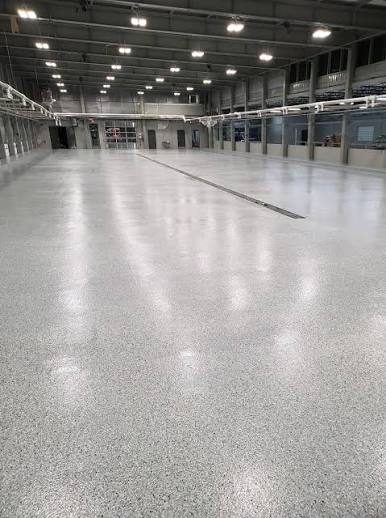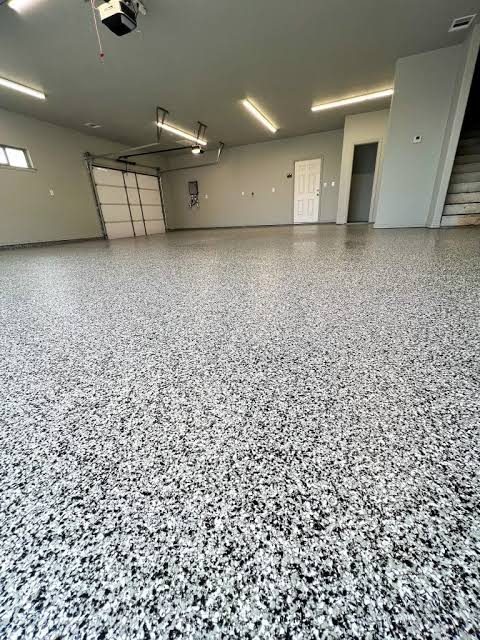
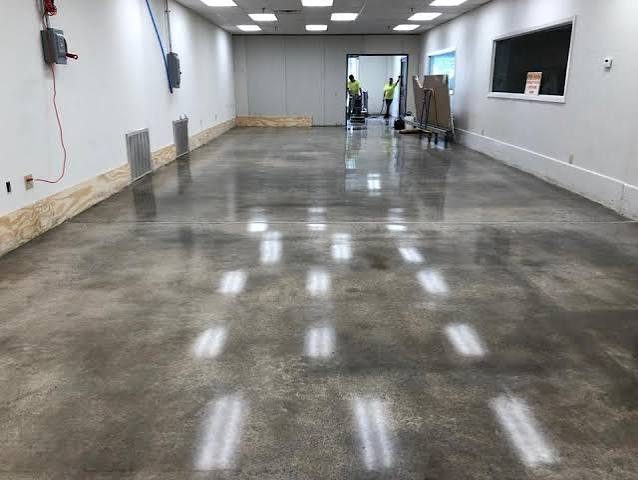
A flooring specification is the document that tells contractors exactly what they're expected to deliver, gives you the basis for evaluating competing bids on equal terms, and forms the contractual foundation for the installed floor. A well-written spec produces competitive apples-to-apples bids, a floor that meets your needs, and a clear standard for inspection and acceptance. A poorly written spec produces confusion, inflated contingency pricing, and floors that don't perform as expected.
Structure: how flooring specs are organized
Most public and institutional construction specifications follow the MasterFormat structure developed by the Construction Specifications Institute (CSI). Flooring work falls primarily in Division 09 — Finishes. The most relevant sections:
- 09 67 00 — Fluid-Applied Flooring (epoxy, urethane, and other resinous systems)
- 03 35 00 — Concrete Finishing (polished concrete, when integrated with the concrete specification)
Each section has three parts: Part 1 (General), Part 2 (Products), and Part 3 (Execution). This three-part structure is standard and worth following even for less formal specifications.
Part 1: General
References
The ASTM standards that apply. For resinous flooring, the most commonly referenced:
- ASTM F1869 — Measuring Moisture Vapor Emission Rate Using Anhydrous Calcium Chloride
- ASTM F2170 — Determining Relative Humidity in Concrete Floor Slabs
- ASTM D4541 — Pull-Off Strength of Coatings Using Portable Adhesion Testers
- ASTM E303 — Measuring Surface Frictional Properties
- ICRI Technical Guideline No. 310.2 — Selecting and Specifying Concrete Surface Preparation (the CSP standard)
Submittals
Defines what the contractor must submit for approval before work begins. Typically includes: product data sheets for each component, Safety Data Sheets (SDS), color samples (minimum 12"x12" drawdowns), manufacturer's installation instructions, applicator qualification documentation, and test reports for required performance criteria.
Quality assurance
Applicator qualifications (minimum experience, manufacturer certification, references), mock-up requirements (a test area of typically 100–200 sq ft installed and approved before full installation), and a pre-installation conference requirement are all appropriate elements.
Project conditions
Environmental requirements for installation: minimum concrete and ambient temperature (commonly 50°F minimum), maximum relative humidity, minimum time after concrete placement before coating. These are typically drawn from manufacturer requirements but must be explicitly stated in the spec.
Part 2: Products
Manufacturers
Either by proprietary product name ("as manufactured by Sika, Stonhard, or approved equal") or by performance specification (specifying criteria the product must meet without naming manufacturers). Proprietary specs simplify evaluation; performance specs encourage competition but require more careful submittal review.
System description
A complete description of each component:
Primer — type (epoxy, moisture-tolerant epoxy, moisture mitigation), solids content, theoretical coverage rate, minimum application thickness.
Base coat — resin type, solids content, color, minimum DFT (dry film thickness in mils), broadcast aggregate if applicable.
Topcoat — resin type (specify "aliphatic" for UV stability), finish level, minimum DFT, chemical resistance requirements, slip resistance requirement (minimum DCOF). The total system DFT should be specified: "Minimum total system DFT: 20 mils, not including aggregate."
Performance requirements
Quantitative criteria the installed system must meet. Common requirements for industrial epoxy floors:
- Compressive strength: typically >10,000 psi
- Bond strength (ASTM D4541): minimum 200 psi, failure in concrete substrate
- DCOF (wet): minimum 0.42
- Chemical resistance: specify chemicals and test method
- Abrasion resistance: Taber abrader results at specified cycles and wheel weight
Part 3: Execution
Examination and substrate preparation
This section should be detailed and specific:
Moisture testing requirements — specify the test method (ASTM F1869 or F2170), when it must be performed (after surface preparation), and the maximum acceptable result. Specify what happens if readings exceed the limit — contractor notifies owner's representative and proposed mitigation is reviewed before proceeding.
Surface profile requirements — specify the required CSP per ICRI Guideline No. 310.2. For most epoxy systems, CSP 3–5 is appropriate. Specifying the profile rather than the method allows contractors to use appropriate equipment for the conditions.
Contamination requirements — surfaces must be free of oil, grease, curing compounds, previous coatings, and other materials that impair adhesion.
Crack and joint treatment — specify the approach for dormant cracks, active cracks, and control joints, including acceptable repair materials and required cure time before coating.
Application
Specify the application method for each component, required time between coats (both minimum and maximum), wet film thickness monitoring requirements, and prohibited conditions (no application over damp surfaces, no application when substrate temperature causes product to exceed upper application limits).
Field quality control
Inspection requirements during construction: owner's right to inspect prepared substrate before coating application, required wet film thickness checks during application, post-installation adhesion testing (ASTM D4541) at a specified frequency, and documentation requirements — photographs of prepared substrate, coating application records including product lot numbers.
Warranty
Specify the required warranty: term (commonly 2–5 years for commercial), what it covers (adhesion failure, defects in materials and workmanship), exclusions (damage from impact, improper maintenance, exposure beyond specified limits), and the required claims process.
The most common spec mistakes
Underspecifying surface preparation — if the spec doesn't define required surface profile, moisture limits, and contamination requirements, contractors interpret them differently and the low bidder takes shortcuts. Omitting DFT requirements — without minimum thickness requirements, product can be stretched beyond what the performance data supports. Not requiring submittals — without a review process, product substitutions happen without evaluation. Vague warranty language — a warranty that doesn't specify what it covers and excludes is worth little. Be specific on all of these.